4 Hao Wang’s Logical Journey in Life
Abstract
- Hao Wang (1921-1995) was a prolific philosopher and researcher known for his close intellectual companionship with Kurt Gödel during the last decade of Gödel’s life, yet “rather little has been published on Wang’s considerable body of work or on the man’s personality and unusual personal history.”1 Wang spent the first 25 years of his life in China, where he studied both Chinese and Western philosophy earning an MA in philosophy at Tsinghua University in 1946 before studying at Harvard. Wang study of mathematical logic in China was sufficient advanced for him to complete his Ph.D. under Quine in less than two years. As his Chinese classmate and lifetime friend He Zhaowu remarked at Wang’s memorial: “Yet his whole life from beginning to end was ‘chock full of contradictions,’ be it in his thought, in his studies, or in his personal life. These contradictions were not only of his own, they belonged also to a part of the difficult course of an entire generation and people.”2 The goal of this article is to see what light Wang’s life and philosophical work can shed on Chinese philosophy and the Western analytic tradition.
1 Gary R. Mar is an Associate Professor of Philosophy at Stony Brook University where he is also the Founding Directors of the Philosophy Department Logic Lab and the Asian American Center. He was the last dissertation student of the 20th century logician Alonzo Church and co-author with Kalish and Montague of the logic textbook Logic: Techniques of Formal Reasoning (second edition, OUP) and the catalyst for the expansion of the APA Committee on Asian and Asian-American Philosophers and Philosophies. Email: Gary.Mar@stonybrook.edu.Charles Parsons and Montgomery Link in their preface to Hao Wang: Logician and Philosopher, a collected work published 15 years after Wang’s death, p. 1.
2 He [1995], translated in Parsons and Link [2011], 49, italics mine.
Keywords: History of Analytic Philosophy, Chinese Philosophy, Orientalism, Hao Wang, Gödel, Wittgenstein, Critical Race Theory, Asian American Philosophy3
3 This paper is the result of participating in a panel “The Analytic Tradition and Chinese Philosophy” at the 2016 Eastern Division Meeting of the APA sponsored by the Committee for Asian and Asian-American Philosophers and Philosophers. For the history of the usually long name of this committee, see (APA Newsletter on Asian and Asian-American Philosophers and Philosophies, Spring 2003 (vol. 2, no. 2), 2).
4.1 Hao Wang’s Journey.
On May 20, 1921 Hao Wang Hao (or, in Chinese, 王浩 Wáng Hào) was born into a family of intellectuals in Jinan, Shandong Province, China. Hao learned from his parents, who were teachers, both Chinese tradition and modern European-American approaches to science, art, and politics. The influence of Western approaches was brought about by Sun Yat-sen’s Revolution of (1911–12) that overthrew the Qing (or Manchu) Dynasty. Wang early education was in the context the “Post-May Fourth Movement in China” (Wang’s phrase in (Wang 1993), p. 40), which was inspired by the May 4th, 1919 student demonstration in Tiananmen Square to protest Japanese and Western imperialism in the aftermath of World War I.
4 Wang’s phrase in Wang [1993].
“During the War of Resistance”4 (the second Sino-Japanese 1937 - 1945), Hao earned B.Sc. Mathematics from National Southwestern Associated University (a consortium of Peking, Tsinghua and Nankai Universities) with the intention of using mathematics as a foundation for philosophy, which Wang pursued rather than engineering which was in vogue at the time. In 1941 Hao married Yenking, his first wife, which was the same year that both China and the U.S. entered into World War II. Wang wrote his “virgin work” in philosophy (in Chinese), a study of Hume’s problem of induction in 1942, which was also the year President Franklin Roosevelt issued Executive Order 9066 authorized the force relocation and incarceration of 110,00 persons of Japanese descent living in America, 2/3 of whom were American citizens. In 1943 about 30 million people were dying of starvation in China, while in the U.S. the Magnuson Act was passed to repeal the 1882 Chinese Exclusion Act, the first immigration law in U.S. history to target a group for exclusion by race and class, given that China and the U.S. were allies.
Having taken all the courses in mathematical logic offered at his university in China, Hao agreed to form a reading group with two of his professors to work through Hilbert and Bernay’s Grundlagen der Mathematik. After Hao presented the first chapter, however, the professors were unable to continue. Wang notes, “I also became lazy… [and] it wasn’t until seven or eight years later, when I was going to teach a class on that subject, that I finished reading the whole book.”5 Wang’s Chinese writings include “The metaphysical system of the New Lixue” [1944], “Language and Metaphysics” [1945]. Wang characterizes the time of his education as during the “Post-May Fourth Movement” which was characterized with disillusionment with the Chinese Republic and traditional Chinese culture to protect China from imperialism. A recurrent theme of Wang’s Chinese writings was the dilemma facing Chinese intellectuals in light of the Opium Wars (1839 –1842, 1856 – 1860).
5 Wang [1982], Parsons and Link [2011], 31.
In 1945 Wang earned his M.A. in Philosophy at Tsinghua University. “During the defense,” Wang recalled, “Professor Shen Youding asked me why I wanted to study philosophy. I said I was interested in the human dilemma. Professor Shen said, ’In the West it is literature that focuses on the human dilemma, not philosophy.” This was the same year that Truman ordered atomic bombs to be dropped on Hiroshima (Aug. 6th) and Nagasaki (Aug. 9th) after which Japan surrendered (Aug. 15th).
The following year at the age of 24 Wang left China on a U. S. State Department scholarship, to study philosophy at Harvard.6 Given his background in mathematical logic in China, Wang was able to complete his dissertation An Economical Ontology for Classical Arithmetic under Quine in one year and eight months, becoming Quine’s fifth dissertation student. Wang then became a Junior Fellow of the Society of Fellows at Harvard. During this time Wang was able to find an elegant repair for Quine’s inconsistent first edition of Mathematical Logic [1946] and demonstrate the consistency of his proposal relative to Quine’s New Foundations, a repair adopted and acknowledged by Quine in the second edition (Quine 1951). In October of 1949 Mao Zedong declared the existence of the People’s Republic of China (PRC), and China, who had been an ally, became a communist threat. McCarthyism created a climate of anti-Communism domestically and the U.S entered into the Korean War (1950-53).
6 The Chinese Exclusion Act [1882], and its various amendments (strengthened in 1884 and expanded by the Scott Act (1888)) and renewed (the Geary Act (1982) and again in 1902 without termination date) made Chinese immigrants permanent aliens by excluding them from U.S. citizenship, so that Chinese men in America had little chance of starting families in America. Although the Chinese Exclusion Act was “repealed” by the Magnuson Act (1943), this act only raised the quota of 100 Chinese per year from anywhere in the world to 105 as compared to a quota of 65,721 immigrants from Great Britain and Northern Ireland. In preparation for entering into World War II, through the “Lend-Lease” program, President Franklin D. Roosevelt had $1.6 billion to invest in China.
During the academic year 1950-1951, Wang studied in Zurich under the auspices of Paul Bernays, where he pursued the philosophy of mathematics, with a specialization in the type of predicative mathematics advocated by Bernays. Wang worked on questions of the relative strengths of axiomatic set theories and pioneered the revival of Hermann Weyl’s work on predicative mathematics, which takes its motivation from Russell’s “Vicious-Circle Principle.” In 1953 Wang contributed his own principle of autonomous iteration as a natural extension of predicativism.
In the Spring of 1955 Wang was invited to be the second philosopher to deliver the prestigious John Locke Lectures at Oxford and then became a reader in the Philosophy of Mathematics at Oxford. This period coincided with the beginning of U. S. involvement in Vietnam (1955 – 1975). In 1956 Wang received a letter from Chancellor Ma Yinchu of Peking University offering him a teaching position, but Wang declined at the time because of interest in pursuing philosophy. Two years later the Cultural Revolution forced Chancellor Ma to resign making it impossible for Wang to retrun to China. Jane Wang (Hsiaoching) was born in Oxford to Hao and Yenking in 1957.7
7 Jane would grow up and become a jazz musician (Boston) and her brothers San-You and Yi-Ming became a doctor (Boston) and an astrophysicist (Washington), respectively.
8 Wang [1982], in Parsons and Link [2011], 35.
9 He [1995] in Parsons and Link [2011], 50.
In the Spring of 1958 Wang arranged for his teacher Professor Jin Yuelin who had promoted logic in China, to report to a meeting of Oxford philosophy professors in which Jin explained why he had abandoned academic philosophy and become a Marxist. Wang, who wrote beautifully but whose English could be difficult to understand, remarked, “Most of the professors who heard the lecture felt his proof a bit too simplistic. But because Professor Jin’s British English was especially elegant and polished, the majority of Oxford professors treated him with utmost respect.”8 At this time, the Soviet Union, under the influence of Marxist philosophy, denounced mathematical logic “as a conceptual game of capitalist class idealism”.9
Upon returning to Harvard, Wang offered a professorship, not in Philosophy where most of his contributions, research and passion had been devoted, but in Applied Mathematics. Ahead of his time, Wang found ways to create academic partnerships with the emerging computer industry. While at IBM Wang (Wang 1961) invented a representation of formal systems known as Wang Tiles, graphically represented by square tiles with a color on each side. Wang’s student Robert Berger (Berger 1966) demonstrated in his dissertation the Undecidability of Wang’s Tiling Problem by showing its decidability would contradict Turing’s proof of the Unsolvability of the Halting Problem. Berger also found a counterexample to Wang’s conjecture that there were no aperiodic Wang Tilings.10 Wang popularized his geometrization of logic in his Scientific American article, “Games, logic and computers” (Wang 1965).
10 Computational ideas have been a catalyst for contemporary philosophical investigations and speculations, e.g., Wang Tiles serve as the plot engine for a short story “Wang’s Carpets” by Australian science fiction writer Greg Bear [1995], a reflection on the nature of reproduction, life, and intelligence in a post-human context.
11 This was two years after the Hart-Celler Naturalization and Immigration Act (19654), which removed the quota system and, for the first time in U. S. history, put Asian immigrants on an equal footing with other nations.
12 van Heijenoort [1967], vii.
Becoming an American citizen in 1967,11 Wang moved his academic home from Harvard to Rockefeller University where he headed a research group in logic and computation. Wang began corresponding with Gödel while helping select and clarify various passages on the logical writings of Skolem for Jean van Heijenoort’s classic anthology From Frege to Gödel.12 In October of that year Wang began his weekly conversations with Gödel at the Institute for Advanced Studies at Princeton. The first series of conversations from 1971 - 1972 influenced significant parts of Wang’s From Mathematics to Philosophy (Wang 1974), which were published subject to Gödel’s approval. The second series of conversations with Gödel began in the Fall of 1975. These remarkable conversations are chronicled and commented upon in four of Wang’s books beginning with From Mathematics to Philosophy (1974) and continuing in Beyond Analytic Philosophy (Wang 1986), Reflections on Kurt Gödel (Wang 1987) and his posthumously published A Logical Journey: From Gödel to Philosophy [1997].
Even with the publication of Solomon Feferman’s et al. monumental 20-year project, the Collected Works of Kurt Gödel, vols. I–V [1986 - 2003], Wang’s pioneering books remain significant because they provide the philosophical background missing in Gödel’s published papers and even in his Nachlass. The philosophical themes or threads that run through Gödel’s work remain unstated not because they were secret but because they were so interwoven into the fabric of his thought that it was unnecessary for him to spell them out. Wang books on Gödel made mathematicians aware of the philosophical views that led to Gödel’s remarkable theorems and showed philosophers how philosophical views could be made mathematically rigorous. Wang’s accounts of his conversations with Gödel [1974, 1985, 1987, 1996] remain invaluable to philosophy. In China Hao Wang “was publically acknowledged as the inheritor of the mantel of Gödel”, but as Parsons and Link add in a footnote “an acknowledgement that would not extend globally.”13
13 He [1995] in Parsons and Link [2011], 50, footnote 4.
4.2 Hao Wang’s Contradictions in Life.
Charles Parsons and Montgomery Link, in their editorial preface to Hao Wang: Logician and Philosopher [2011], a memorial volume not assembled until 15 years after Wang death, make an intriguing observation:
Clearly [Wang] never lost his identification as Chinese, and we think he resisted being categorized as Chinese-American or Asian-American, although he did become an American citizen in 1967. The influence on him of Chinese culture and thought comes through in a number of his writing, maybe especially in his reaction to the very Western rationalism of Kurt Gödel, which fascinated him but which he could never fully embrace.
There is no reason to question the editors’ opinion with regard to Wang’s preferences about terms he would use to express what we would today call his “identify politics.” The asymmetry of the hyphenated terms “Chinese-American” or “Asian-American” typically implies that one is referring exclusively to a type of American. However, a different question can be raised. We can use terms with solidus (e.g., “Chinese/American” or “Asian/American”) to refer to Wang’s status as an individual of Chinese or Asian descent residing in America. What facts about the racial formation of Asian/American intellectuals during Wang’s lifetime shaped their life prospects and career possibilities?
Charles Parsons has, perhaps, done more than any other philosopher to bring the unduly neglected accomplishments of Hao Wang to the attention of the APA. However, Parsons’ repeated remarks on of Wang’s “Chineseness” may hide the complexities of racial formation faced by Wang and his generation. Parsons notes that Wang essentially thought of himself “as simply Chinese, a member of the Chinese diaspora that has existed for centuries.”14 Parsons characterized Wang’s extensive exchanges with Gödel as “conversations between two thinkers with synoptic ambitions, one of whom sought resources from earlier Western traditions, and the other of whom, however Western his training and career, never ceased to be Chinese.”15 Parsons characterized Wang’s responses to Gödel’s discussions of Weltanschauung (e.g., of pre-Kantian rationalism and Leibnizian optimism) as “show[ing] his Chinese cultural background.”16
14 Parsons [2002] 28, italics mine.
15 Parsons, op. cit., italics mine.
16 Parsons [2011], 78, footnote 30, italics mine.
17 The solidus notation in ‘Chinese/American’ is here used inclusively for being both Chinese and American and avoids the asymmetry of the label ‘Chinese-American’ which typically refers exclusively to a type of American.
The characterization of Chinese in America as part of the global diaspora of “Overseas Chinese” is often used to explain why Chinese failed to assimilate and to become American. This cultural explanation blames culture for the isolation and marginalization that Chinese/American17 intellectuals faced and ignores the more subtle forces of racial formation operating on Oriental scholars in American academic institutions. The construction of the Oriental as a “sojourner” in the West whose life goal of the triumphant journey home often functioned as a rationalization. This dream of returning home served as a powerful defensive mechanism for many Chinese/American intellectuals coping with social isolation and professional discrimination.
Professional Orientalism in the careers and outlook of academics of Asian descent in America has been examined by Henry Yu in Thinking Orientals (Yu 2001) a sociological study of historical transition from “gentlemanly to institutionalized Orientalism” experienced by intellectuals of Chinese and Japanese descent living in the American from 1920 – 1965. Yu’s study focuses on the Chicago School of Sociology, spear-headed by Robert Ezra Park (1864–1944), who with the help of his mid-westerner colleagues, recruited Oriental scholars, but the same sociological forces and racial formations were faced by other academics of Asian descent.
In Chapter “Strangers from the Midwest: Robert Ezra Park and Other Men with Three Names” of Thinking Orientals, Yu explains why these Midwestern sociologists were so interested in Orientals and how their outlook was conditioned by orientalism. The conceptual link between the European white immigrant and the Negro non-white non-immigrant was provided by the Oriental, who was both immigrant and non-white. The “Oriental Problem” was to explain the cultural inability of Orientals to overcome the last stage of the assimilation cycle, which the Chicago School equated with becoming American. Park and his associates sought an explanation of the failure of Orientals to become American through a cycle of assimilation, not in terms of racial formation, but in terms of cultural distance.
Robert Park, blinded by his culturalist assumptions, came to think of the Oriental face as a mask that could disguise the inner thoughts and feelings, which is strikingly evidence in the following passage: “I recently had the curious experience of talking with a young Japanese woman who as not only born in the United States, but was brought up in an American family, in an American college town, where she had almost no association with members of her own race…. I found myself watching her expectantly for some slight accent, some gesture or intonation that would betray her racial origin… When I was not able, by the slightest expression, to detect the Oriental mentality behind the Oriental mask, I was still not able to escape the impression that I was listening to an American woman in a Japanese disguise.”18
18 Yu [2001], 67.
Quine in his autobiography The Time of My Life characterizes Wang as “persistently unhappy” during his time at Harvard. This begs the question: did Hao Wang have reason to be unhappy? Recall that Wang, having already studied mathematical logic in China, wrote his dissertation under Quine in under two years. Wang had repaired Quine’s inconsistent system in Mathematical Logic, had spent five years at Oxford where he was invited to be the second philosopher to give the John Locke Lectures. The topic of Wang’s lectures was “On Formalizing Mathematical Concepts.” Wang had been preceded by O. K. Bouwsma and was followed by a distinguished list of philosophers: A. N. Prior, A. C. Jackson, Gregory Vlastos, Nelson Goodman, Jaakko Hintikka, Wilfred Sellars, Paul Lorenzen, Noam Chomsky, Donald Davidson, Saul Kripke, Hilary Putnam, and so forth. Wang’s time at Oxford overlaps with his first period of engagement with the philosophy of Wittgenstein (1953 – 1958).
Upon returning to Harvard, Wang as offered a position, not in Philosophy, but in Applied Mathematics. Juliet Floyd reports: “In conversation Wang told me that one reason he had found his professorship at Harvard unsatisfying is that he was appointed in the Department of Applied Mathematics, and not in Philosophy, where he felt the bulk of his efforts and his contributions had been made.”19 Quine was a mid-westerner with roots in Akron, Ohio with three names, a fact that he proudly details in The Time of My Life (1986): he was the child of Colye Robert Quine and Harriet (“Hattie”) Ellis née van Orman named after a mathematician.20 One wonders why W. V. O. Quine did not intervene on Wang’s behalf.
19 Floyd [2011], 157 footnote 17.
21 Floyd [2011], 146.
22 Floyd ([2011], 87) herself regarded Wang as a mentor who provided her with an authentic example of what the Chinese call xiansheng (先生, teacher, master).
Juliet Floyd notes: “Wang’s role in shaping more than one generation’s understanding of the fundamental problems in logic and their history through the 1950s was significant, and not as widely acknowledged as it should be…. Because Wang taught at Harvard and Oxford, the cumulative impact of his teaching on the dissemination of logic was significant…. Hide Ishiguro has stressed to me how supportive Wang was of Michael Dummett during his early years teaching at Oxford, when logic was not a very popular subject among philosophers there.”21 Among Wang’s students who went on to have distinguished careers as philosophers and logicians were Charles Parsons, Burton Dreben, Michael Dummett, Donald A. (Tony) Martin, and Hilary Putnam.22
Wang expressed his dissatisfaction with analytic philosophy in Beyond Analytic Philosophy: Doing Justice to What We Know (Wang 1986). Quine, who described himself as a “disciple of Carnap for six years,” declared his independence from Carnap his celebrated “Two Dogmas of Empiricism” (Quine 1951) [1951, 1961].
[DATE]. Similarly, Wang playfully labeled Quine’s philosophy “Logical Negativism” (a contrast that plays off of Carnap’s “Logical Positivism”) which captures Quine’s peculiar combination of local precision and global indefiniteness, supported by such negative Quinean dogmas as the “indeterminacy of translation,” the “inscrutability of reference,” and, to borrow Gilbert Harman’s phrase, the “death of meaning.” Supported by vaguely enunciated pragmatic appeals to semantic holism, Quine’s logical negativism not only “failed to do justice to what we know”—but, ironically Wang noted, failed to give an adequate account of logic, mathematics, and science, the disciplines from which Quine’s philosophical positions drew their rhetorical strength. Wang’s criticism of Quine was frustrating to analytic philosophers trained to publish “piecemeal exercises” of focused argument analysis and to diagnose arguments in terms of precisely defined logical failings.
Instead of adopting a piecemeal approach, Wang’s writings aimed at perspicuity—clarity of the sort that can be found in an elegantly arranged mathematical proof or an insightfully arranged set of quotations. Wang was known for his ability to locate a philosophical position in intellectual history—a history not told dramatically but with discerning and judicious insight.23 Floyd characterizes Wang’s synoptic style of argument: “When arguments are found in Wang, they are deductions from his observations, or relative comparisons of the interest and correctness of different responses, concepts, or principles. The tone of the whole is always tentative, pluralistic, and … synoptic rather than systematic in aim.“24
23 Floyd [2011], 156.
24 Floyd [2011], 18.
Wang was concerned that philosophy “do justice to what we know.” He characterized his major statement on the philosophy of mathematics, From Mathematics to Philosophy, not in terms of constructing a grand theory, but in terms of seriously collecting data:
This book certainly makes no claim to be philosophical theory or a system of philosophy. In fact, for those who are convinced that philosophy should yield a theory, they may find here merely data for philosophy. However, I believe, in spite of my reservations about the possibility of philosophy as a rigorous science, that philosophy can be relevant, serious, and stable. Philosophy should try to achieve some reasonable overview. There is more philosophical value in placing things in their right perspective than in solving specific problems. Both hasty speculations and piecemeal persistence on artificial issues tend to hamper cumulative progress in philosophy.25
25 Wang [1974], x.
As an active researcher in the emerging field of computational logic, Wang was able to see the impediments imposed by Quine’s overly narrow analytic conception of logic pronouncing limitations on the proper scope of philosophical and logical inquiry. Wang, in his contribution to Quine’s “Schilpp volume” one year after his critique in Beyond Analytic Philosophy, sharpened his critical assessment: “for the working logicians, much of Quine’s work is thought to be off the mainstream.”26
26 Wang’s contribution in Schilpp [1986], 635.
Eckehart Köhler was scholar interested in Gödel’s Platonism, who first contacted Wang in 1979 on the advise of Solomon Feferman, and who later in 1986 as founder of the Kurt Gödel Society in Vienna invited Wang to become its first president. Köhler in his “Collaborating with Hao Wang on Gödel’s Philosophy” (Köhler 2011) in the memorial volume recounts a revealing with Wang:
I began explaining to Wang the well-known work of Herbert Simon, a major figure in Artificial Intelligence. He and his students had done some of the best work on scientific discovery, using AI methods. (I had at other times tried explaining related concepts of decision theory, statistical weighing of evidence, concepts of probability, in attempting to justify Gödel’s famous claim that mathematical knowledge is analogous to empirical knowledge, especially…. Wang practically exploded. He was disgusted with Simon and did not want to hear a thing about him, and considered him an execrable logician. Wang would brook not contradiction, so I changed to topic (Köhler adds in a curious footnote: “Oddly enough, Simon… spent quite a lot of time in China and had learned Chinese.”)
Köhler speculates on the source of Wang’s anger:
Without knowing any details of Wang’s work in computer proofs, I am sure that he was a logician vastly superior to Simon, and I suppose he got sick of hearing form AI researchers that Simon was allegedly the first to do an AI logic proof. I am also sure that Simon was would agree with Wang that the proof he presented at the famous 1956 AI-conference was utterly trivial and without much inherent merit.
Let’s examine some of the logical and historical details before drawing any conclusion about Wang’s anger. Newell and Simon wanted to program a computer to carry out heuristic problem solving through symbol manipulation, and they considered such problems as playing chess, the solving of geometrical problems, and, as an afterthought, proving logical theorems. In 1955 Simon claimed “over Christmas Allen Newell and I invented a thinking machine”27 because he had simulated “by hand” a proof from Whitehead and Russell’s Principia Mathematica, but it wasn’t until August 1956, that the Logic Theorist program actually run on RAND’s Johnniac computer (named after von Neumann) completed the proof of theorem 2.01.
27 McCorduck [1979], 116.
The Logic Theorist was given a list of axioms and definitions and kept in memory a list of previously proved theorems. When it is given a new logical theorem to prove, it runs through all the operations of which it is capable searching for a proof. Consider a proof of theorem 2.01:
\[ \text{2.01} \vdash \neg(p \to \neg p) \to \neg p \]
The program would have had as an axiom
\[ \vdash (p \lor p) \to p, \]
which by a rule of substitution of ~p for p could obtain
\[ \vdash (\neg p \lor \neg p) \to \neg p, \]
from which, in turn, by a rule of substitution of equivalents, in particular, an instance of the definition
\[ p \to q :=: \neg p \lor q \]
could obtain the required theorem.
It should be kept in mind that Newell and Simon structured the problems given to the program, including the order in which they were given. In other words, it could be argued that the Logic Theorist did not by any stretch of the imagination show that one could mechanize Gödel’s notion of intuition: the program was only doing what it had been programmed to do in a very limited realm of problem solving. Eventually the Logic Theorist was able to prove 38 of the first 52 propositional theorems. About half the proofs accomplished in less than a minute, most of the remainder taking between 1 – 5 minutes, some taking as much as 15 – 45 minutes.
How did this compare with Wang’s accomplishments? In 1959 Wang programed an IBM 704 computer to prove all the logical theorems (over 350, including theorems involving not only propositional logic but also predicate logic and identity) of Principia Mathematica in less than 9 minutes. In contrast to Herbert, who triumphantly announced his accomplishment as showing the power of AI to simulate human logic, Wang regarded his accomplishment as demonstrating the “essential lack of conceptual richness” of Russell and Whitehead’s Principia Mathematica.28 Wang help to define the new research area of ATP (automated theorem proving) and to show how it rested upon results in mathematical logic.
28 Floyd [2011], 164.
This work would be the basis of his later work (Wang [1960, 1961, 1963]) on the \(\forall\exists\forall\) case of Hilbert’s Entscheidungsproblem. Instead of stocking the computer program with ad hoc “heuristics,” a research program which has since gone out of style, Wang programmed the “cut-free” formalisms of Herbrand the Gentzen and emphasized the importance of algorithmic pruning, which could eliminate useless terms in advance. Furthermore, Wang provided a well-conceived list of theorems of predicate calculus that could serves as “benchmarks” for judging the effectiveness of new theorem-proving programs. For these achievements Wang would eventually be awarded in 1983 on the recommendation of a committee composed of David Luckham, John McCarthy and chaired by Martin Davis the first Milestone Prize for Automated Theorem Proving (ATP) by the International Joint Conference on Artificial Intelligence.
To return to Köhler account, Köhler found Wang’s reaction to be inconsistent:
A few days after the clash on Simon, while musing on Gödel’s notion of intuition, I mentioned how close it seemed to what AI people (following Simon) now call heuristics; … Wang again rebuffed me, calling this too “scientistic.” I slyly hinted that his refusal to consider the idea violated his own injunction “to do justice to what we know.” Wang of course immediately got the point and did not reply….
Perhaps even more inconsistent is the suggestion that Wang’s silence indicated his capitulation to Köhler’s criticism. One cannot dismiss the legitimacy of Wang’s anger on the grounds of Wang’s incivility or Wang’s silence. Anger towards institutionalized discrimination can be a legitimate and healthy response. It is presumptuous for more privileged parties to assume that unrecognized parties expressing anger “be civil” before their complaints can be given a hearing, especially when this requires, in effect, that they case cease making forceful points about unfairness. Silencing of those in subordinate positions protects institutionalized discrimination by removing any record of wrong. The vicious circle principle of silencing can work in two ways—when one’s colleagues dismiss one as a knower with a legitimate perspective due to one’s anger and when one in frustration perceives one’s colleagues as unwilling or unable to listen to one’s testimony and so engages in self-censoring.
This vicious silencing principle is a form of racial formation is often at play in academic circles. This principle combines stereotyping with an asymmetrical application of a principle of civility. When someone from the dominant group is uncivil, this very incivility is valorized as being “forthright” or “refreshingly honest” or even “courageous.” However, when those from a subordinated group are uncivil, perhaps uncharacteristically, this angry outburst is used as grounds for not taking their complaints seriously. For example, the silencing response “I can’t hear you when you’re angry” to Black or women philosopher is now widely acknowledged as ways of illegitimately delegitimizing the criticism.
Oientalism functions not only professionally but personally. Scholars of Asian descent establishing themselves as academics in America during Wang’s generation would often re-orient their lives selectively around acceptable Asian values (e.g., Chinese culture and philosophy) while distancing themselves from cultural traits considered to be un-American (e.g., clannishness and indirectness). Ever since his youth Wang conceived of philosophy as a more holistic enterprise: “One might wish to say that the task of every philosopher is to describe eventually ‘the world as I see it’ and that his achievement is to be evaluated by how significant a picture he gives.”29
29 Wang [1974], 334.
Henry Yu’s book takes as a case study Rose Hum Lee (1904–1964), a first generation Chinese American, who was the first woman to become chairman in an American university (to succeed Lee was forced not only to become more modern but also more masculine). In research papers, Lee adopted the cultural analysis of alienation of the Chicago School of sociology and wrote objectively:
To retaliate for not heeding their wishes, they spread tales of her supposed misdeeds in the Midwest, where she attended a famous university. The Chinatowners of this prairie city were delighted to have a plum to pick. No native-born of this group had ever obtained a doctorate in philosopher, though some received their master’s and medical degrees… The local Chinese, instead of being sympathetic to professional attainments, disparaged this girl’s achievements. Her personal life was the subject of slander, gossip, envy and conspiracy. There were no congratulations when her doctorate was awarded.
Perhaps Wang’s self-representation of himself as a “Chinese in exile” was conditioned by the discrimination he faced professionally and personally, a self-presentation that evolved during the two thirds of his life that he lived in America. While Wang was still entertaining thoughts of returning to China—after the birth of the PRC in 1949 but before the Cultural Revolution in China (1966 – 1976) brought about the public persecution of intellectuals—he shifted his research focus to computation with the thought that programming skills would be more useful to China than his research in philosophy. Martin Davis ([2011], 76) in the midst of his account of Wang’s contributions to Automatic Theorem Proving and to Hilbert’s Entscheidungsproblem, recalls a turning point in Wang’s disillusionment:
Like to many others, he eventually became disillusioned with the Maoist order. I remember particularly his telling me of his astonishment at a letter severely criticizing him that he received from his father, a secondary school teacher in China, during the Cultural Revolution. He understood with considerable distress that his father would have written such a letter only under great pressure.
Wang reminisced about how he and his classmate in China He Zhaowu visited each other in 1980 in Kunming and in New York:
I began to doubt my own most recent views. I had imagined certain facts that were grounded in wishful thinking; upon this foundation I had erected a logical construction that really was a castle in the sky….. I remember the pain that bitterness I suffered at the time because of the wrenching transformations of my thinking and the lost of my convictions.”30
30 Wang [1933] in Parsons and Link [2011], 41.
Influenced by Zhaowu’s presentation of the poetic pentology of Bodhisattva Barbarians, Wang wrote a personal essay about “homesickness in a foreign land” but did not publish it regarding it, in the end, as “sick with self-pity” and “nauseating.”31
31 Wang [1992] in Parsons and Link [2011], 44.
4.3 Hao Wang’s Philosophical Journey.
Wang believed that “Philosophy has a longer history and a larger diversity of traditions to select from” (Wang [1986], 192). As an analytically trained philosopher who was an active researcher in logic, Wang contributed an important diagnosis of the misconceived role of logic in Anglo-America analytic philosophy. Wang was in a position to comment knowledgeably on the contradictory roles logic played in Quine’s analytic philosophy: logic was at once excessively emphasized and ineffectively employed:
Directly and indirectly logic plays an important part in much of contemporary Anglo-American academic philosophy…. The way logic is commonly used in philosophy seems to me to do less than justice to the full richness of logic as a study of the foundations of mathematics; and that excessive emphasis on the importance of logic for philosophy, combined usually with a misapplication of logic, seems to me to have led to a far from balanced view of philosophy, especially as it is understood in the traditional sense. Moreover, the much-publicized juxtaposition of logic with positivism (or empiricism or ‘analytic’ philosophy) has burdened logic with a guilt-by-association, resulting in a surprising ignorance of logic on the part of philosophers of other persuasions.32
32 Wang [1976], ix.
As a Chinese philosopher, Wang was attached to a broader view of the philosophical enterprise “beyond analytic philosophy.” In a concluding chapter entitled “Metaphilosophical observations” of Beyond Analytic Philosophy, Wang acknowledges the Chinese influences on his conception of philosophy: “… my professional training is nearly all in Western philosophy (much of it even logic-oriented), yet my formative years were lived in China. I have tried hard but have not been able to shake off my early conviction that philosophy is not just one subject more or less like any other, but something special. Even today such a belief, I think persists in China…. I continue to believe that philosophy should somehow be comprehensive and aim at a unified … outlook…. I find myself attached to the Chinese tradition of mixing together philosophy, literature, and history—a tradition that conditions and is conditioned by the central concerns of its philosophy; the interest in politics ties it and the concern with the unity of nature and person overlaps with art and literature.”33
33 Wang [1986], 194.
To advance the dialogue on such topics as “The Analytic Tradition and Chinese Philosophy,” we need to overcome the duality of viewing philosophy in terms of “East versus West”—in particular, the unexamined tendency to view the relationship in terms of “challenges” or “contributions” to the mainstream. “Challenges” presuppose a false philosophical polarity, e.g., in discussing Eastern versus Western ethics in terms of polar concepts of shame versus guilt tends to stereotype the meaning of each and to discourage remembering cases of ethical reasoning or traditional virtues in which both qualities are present. “Contributions” presuppose one tradition as the philosophical mainstream thereby marginalizing the other as making “contributions.”
Orientalism shaped the disciplinary self-understanding of philosophy. A kind of professional orientalism, also shaped the careers of many academics of Asian descent living in America (as well as England and Europe) as well as their autobiographical self-understanding of themselves as academics. Edward Said famously coined the term orientalism,34 which is used by scholars of Cultural Studies for a type of depiction of the Orient (East Asia, South Asia, and especially, for Said, the Middle East) by writers, artists and scholars from the West. While Said’s use of the term was far too sweeping and impressionistic, scholars in Asian American Studies have more carefully articulated various forms of orientalism.
34 Edward Said’s Orientalism (Vintage Books, New York, 1978), was catalytic, if not always philosophically accurate. Said’s philosophical misconceptions were elaborated in my presentation “Critique of Orientalism” delivered at the Annual Meeting of the Association for Asian American Studies, April 24, 2009.
An essential aspect of Said’s thesis was that orientalism was essential to the West’s self-understanding and self-promotion. Consider Hegel’s claims in his Lectures on the History of Philosophy (1825–1826):
[In the East] conscience does not exist, nor does individual morality. Everything is simply in a state of nature, which allows the noblest to exist as it does the worst. The conclusion to be derived from this is that no philosophic knowledge can be found here.… The Eastern form must therefore be excluded from the history of philosophy…. Philosophy proper commences in the West.35
35 Hegel [1882] in Haldane and Simon translation [1974], 97-98.
Even Bertrand Russell’s more liberal lament over Great Britain’s colonialist policies in The Problem of China (1922) appeals to orientalism to find cultural reasons for the dominance of the West:
The British view is still that China needs a central government strong enough to suppress internal anarchy, but weak enough to be always obligated to foreign pressure…. Possession, which is one of the three things that Lao-Tze wishes us to forego, is certainly dear to the heart of the average Chinaman. As a race, they are tenacious of money—not perhaps more so than the French, but certainly more than the English or the Americans. Their politics are corrupt, and their powerful men make money in disgraceful ways…. Nevertheless, as regards the other two evils, self-assertion and domination, I notice a definite superiority to ourselves in Chinese practice. There is much less desire than among the white races to tyrannize over other people. The weakness of China internationally is quite as much due to this virtue as to the vices of corruption ….36
36 Russell [1967], 552.
Wang himself noted the historical, if not conceptually necessary, collusion between Great Britain’s imperialism and the aesthetic and autonomous morality embraced by its intellectuals:
In the heyday of British imperialism, a rather influential ethical doctrine came out of Cambridge which signaled out esthetic enjoyments and personal affection as good in themselves. In theory, this doctrine does not reject the suggestion that for a long time to come eliminating miseries will be of more moral value than pursuing personal enjoyments. In practice, it has had the effect of enhancing the complacency of intellectual aristocrats.37
37 Wang [1974], 329–30.
In 1985 Wang received honorary doctorates from Peking (China’s ‘Harvard’) and Tsinghau (China’s ‘MIT’) Universities, and was again seriously considering returning to China. Although China was reversing the repressions of the Cultural Revolution under Deng Xiaoping, Wang “sorrowfully torn up his invitation” to teach and do research in Beijing after the 1989 Tiananmen Square massacre.38
38 Köhler [2011], 58.
Racial intermarriage was of special interest to the Chicago School of Sociology because in their minds it was ultimate proof of assimilation and hence, in their view, of becoming American. However, it should be kept in mind that anti-miscegenation laws were in effect since before the United States was a republic and remained in effect until ruled unconstitutional by the U.S. Supreme Court in 1967. For example, prior to the Cable Act of 1922, women, but not men, lost their U.S. citizenship if they married a foreign spouse. The Cable Act guaranteed such women could retain their citizenship but only if married to an “alien eligible to naturalization.” Since at the time of the act’s passage, Asian aliens were not considered to be racially eligible for U.S. citizenship, any woman who married an Asian alien lost her U.S. citizenship.
Around 1988 Wang met Hanne Tierney39 at an invitation-only gathering of artists, academics and other accomplished persons called the “Reality Club.” Hanne Tierney, who would become Hao’s third wife, was a German immigrant, who lived in Prague and journeyed to America by way of England at the age of nineteen. She authored a successful children’s book about her experience in America and then created an avante-garde style of puppetry that offered her a three-dimensional language of sculpture. According to Hanne, Hao characterized the difference between herself and himself: “You are an immigrant, I am an exile.” Hao once explained to her that “China was God”, that is, China served much the same purpose for exiled Chinese as God did in Western religion: what overseas Chinese desired from China was forgiveness, and the good deeds they performed in a hostile environment were done for China. The “Death of God” explains the depth of suffering caused by Wang’s loss of his faith in Marxism and Maoism in 1979. Hao and Hanne visited China together in 1992.
39 After reading Wang’s obituary in the New York Times, I contacted his surviving wife Hanne Tierney, who provided these recollections.
4.4 Wang, Wittgenstein, and Gödel.
Wang approvingly quotes a mimeographed manuscript of Yueh-Lin Chin [1981]: “Chinese philosophers were all of them different grades of Socrateses.”40
40 Wang [1986], 194.
Towards the end of his life, Wang continued to work on a manuscript for Gödel, Wittgenstein and Purity of Mind: Logic as the Heart of Philosophy but had great difficulty in completing his manuscript and set the project aside. Despite his reservations about Gödel’s overly optimistic faith in the “possibility of philosophy as a rigorous science,” Wang unreservedly praised Gödel’s way of life:
Gödel exemplified, I think, a way of life and work that inspires a greater faith in reason, questions the ‘prejudices of the time’ and stirs our imagination to strive for more autonomy by examining our largely derivative sense of what is important in life.41
41 Wang [1987], ix.
While Wang never became a Wittgensteinian, he seriously engaged Wittgenstein’s philosophical insights. Wang’s second period of engagement with Wittgenstein’s philosophy spanned the years 1981 – 1995. Wang admired Wittgenstein’s life-long struggle to achieve perspicuity: “One main difference between Wittgenstein and most contemporary Anglo-American academic philosophers would seem to be the indulgence of the latter in clever, small arguments clouded by all sorts of extraneous detail.” 42
42 Wang [1976], 348.
43 Wang [1986], 193.
Let’s summarize some of our conclusions thus far. As a Chinese/American philosopher, Wang was able to pursue philosophy in ways that embodied the virtues of both the Analytic and Chinese Traditions—e.g., combining the technical precision of Gödel’s meta-mathematical approach to logic as well as the artistic and aesthetic perspicuity of Wittgenstein and Chinese philosophy. As an analytically trained philosopher, Wang was able to correct misconceptions of logic held by many Anglo-American philosophers due to the “guilt by association” in their minds of logic with positivism and the Vienna Circle, a view about the nature of logic that was not held by Gödel, who briefly attended the Circle. As a mathematical logician, Wang was able to provide a meta-mathematical perspective on logic to Chinese logicians. Wang quotes a mimeographed manuscript of Yueh-Lin Chin [1981] written in Kunming in 1943: “One of the features characteristic of Chinese philosophy is the underdevelopment of what might be called logico-epistemological consciousness.”43 As an active researcher in mathematical logic and computation, Wang was ahead of his time in proposing new graphical representations of computability, pioneering collaborations between academia and the emerging computer industry, and proposing new distinctions (e.g., feasible as opposed to theoretical computability). As an Asian/American academic, the trajectory, and limitations, of Wang’s professional career sheds light on the unexamined practices of academic philosophy in the Anglo-American tradition, and the complex sociological dynamics that entered into the formation of the professional and personal lives of the “Thinking Orientals” of a previous generation and still enters into the formation of Asian American philosophers.
4.5 Wang’s Empty Boat.
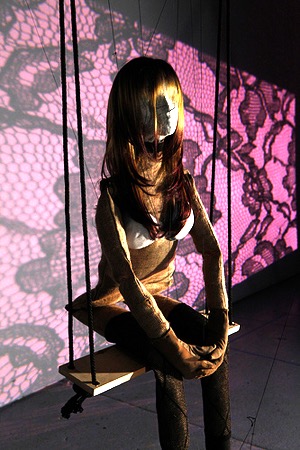
“Hanne Tierney in a Nutshell”
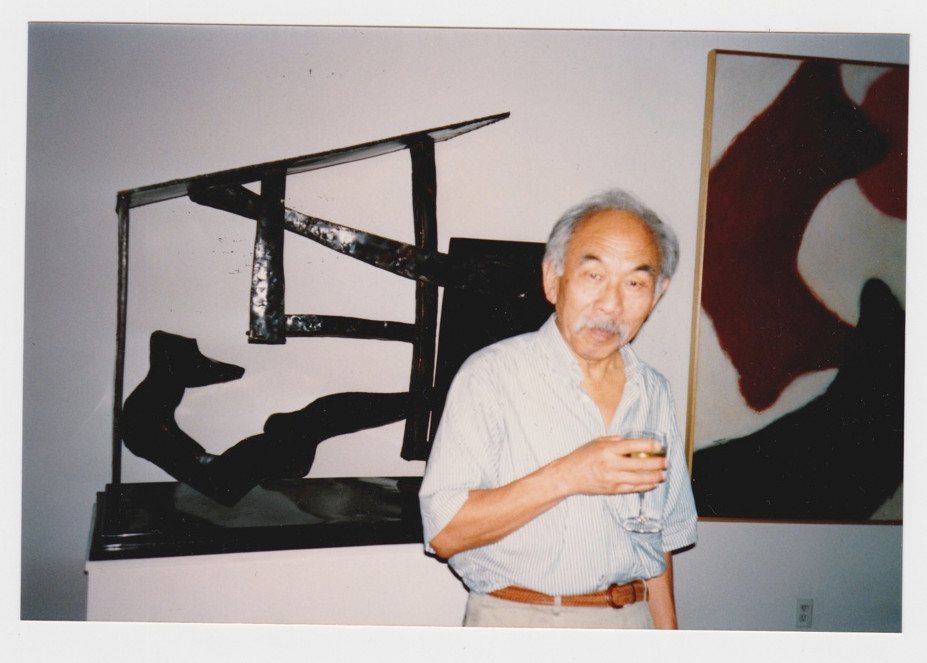
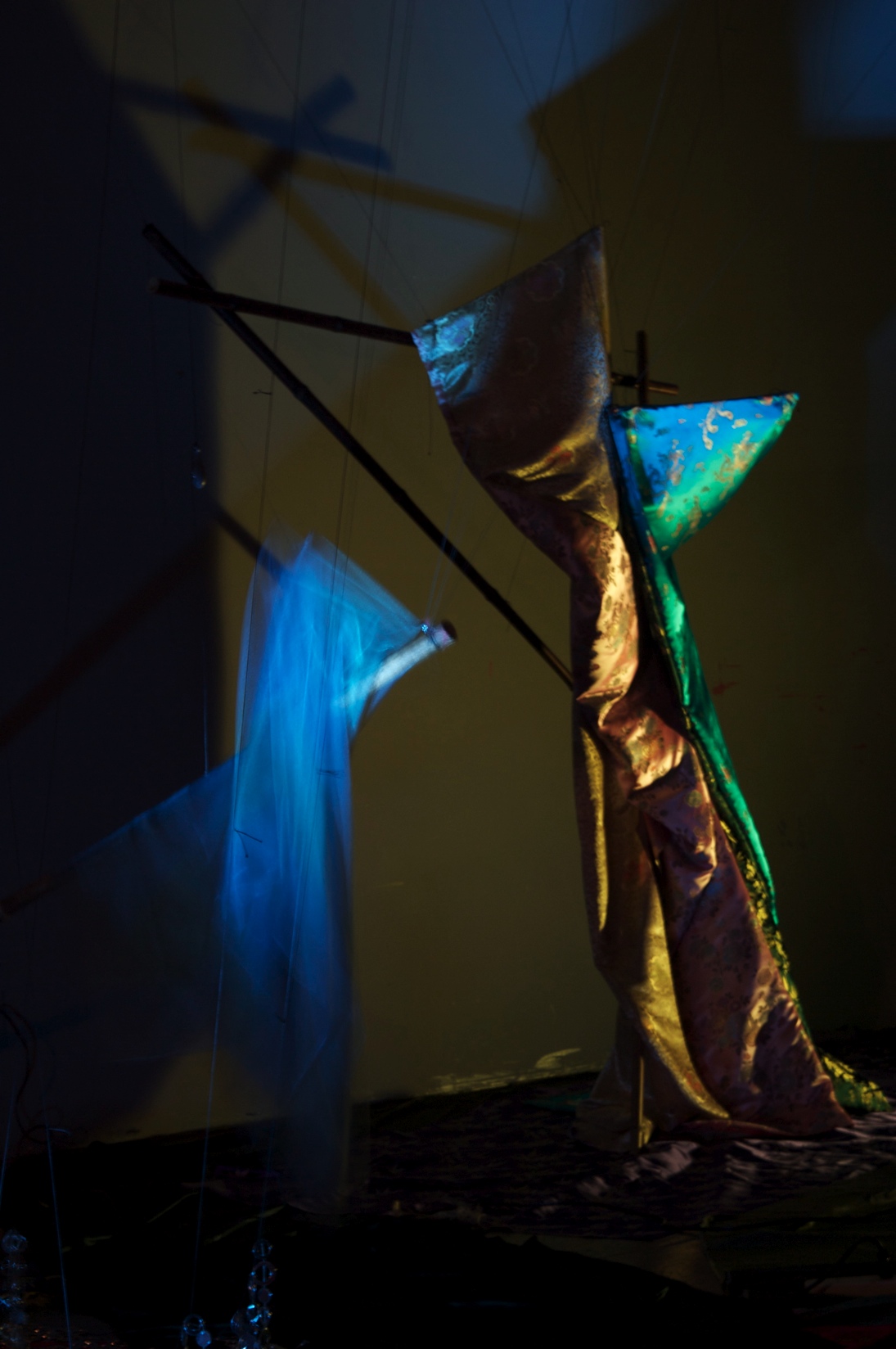
FiveMyles Gallery, 2001
From 1991–1994, Juliet Floyd spent time in the company of Hao Wang and his wife Hanne Tierney and she notes Wang’s return the conception of philosophy that had attracted him as a youth in China:
Wang was inclined to consider artists with as much respect as he did scientists…. Wang’s literary ambitions became stronger over time, and importantly shape his final writings. These bear an important relation to his ideas about “intuition” and his interest in Wittgenstein, whom he came to regard as ‘art centered’ rather than ‘science centered’ in his conception of philosophy…. Wang felt the literary effects of Wittgenstein’s writing were not irrelevant to the content of his philosophy. I think we can assume that Wang felt the same way about his own books…. In the manner of Walter Benjamin, or perhaps better, of his Chinese forebears, Wang often proceeded by arranging quotations, without interpretation, in an effort to draw out the reader’s reflection and response, thereby showing, but not himself directly stating.
One of Wittgenstein’s most memorable sayings in the Tractatus is his famous ladder metaphor:
6.54 My propositions are elucidatory in this way: he who understands me finally recognizes them as senseless, when he has climbed out through them, on them, over them. (He must so to speak throw away the ladder, after he has climbed up on it.)
Wittgenstein’s ladder, Wang noted, evokes the raft of the Diamond Sūtra: 44
44 Wang [1986], 100.
The dharma I am preaching is analogous to a raft (which is to be discarded after use); even the dharma can be discarded, a fortiori the non-dharma.
Wang completed his last book A Logical Journey: From Gödel to Philosophy just months before his death s week before his 74th birthday, which was published posthumously in 1996.
In 2001 Hanne Tierney in collaboration with Wang’s daughter and jazz musician Jane Wang created a performance piece “How Wang-Fo Was Saved”45 at the FiveMyles Gallery in Crown Heights, Brooklyn.
46 Merton [1965], 115. ‘Chuang Tzu’ is another name for Zhūangzi.
The script for “How Wang-Fo Was Saved” was adapted from on a children’s book by the Belgian-born French novelist and essayist Marguerite Yourcenar (1903–1987) that retells an ancient Chinese legend: Captured as he is walking with a disciple, the elderly painter Wang-Fo is brought before the Emperor. Spoiled by the beauty of Wang-Fo’s paintings, the Emperor complains that nothing in reality is as beautiful as the artist’s depictions. Wang-Fo is therefore to be executed for his lies. The Emperor commands Wang-Fo to finish painting one last canvas. Dutifully serving his sentence by completing his last canvas, Wang-Fo first paints a lake, then he draws a rowboat. As the waters rise and fill the Emperor’s throne room, old Wang-Fo climbs into the boat and rows away. What is left behind is an empty boat.46
Who can free himself from achievement
And from fame, descend and be lost
Amid the masses of men?
He will flow like Tao, unseen,
He will go about like Life itself
With no name and no home.
Simple is he, without distinction
To all appearances he is a fool.
His steps leave no trace. He has no power.
He achieves nothings, has no reputation.
Since he judges no one,
No one judges him
Such is the perfect man:
His boat is empty.
We shall end our reflections on Hao Wang’s logical journey with a meditation on Wittgenstein’s famous advice:
Wovon man nicht sprechen kann, darüber muss man schweigen.
Whereof one cannot speak, thereof one must pass over in silence.
Even Wittgenstein could not follow his own austere advice, so perhaps it is more fitting to conclude with the paradoxical humor and literary elegance of Zhūangzi:
荃者所以在魚,得魚而忘荃;蹄者所以在兔,得兔而忘蹄;言者所以在意,得意而忘言。
吾安得夫忘言之人而與之言哉!
The bamboo fish net exists for catching fish. Once the fish is caught, forget the net!
The rabbit snare exists for trapping rabbits. Once the rabbit is trapped, forget the snare!
Words exist because they are used for expressing meaning. Once the meaning is grasped, forget the words!
Where can I meet those who have forgotten words and have a word with them?47
47 I am indebted to Professor T. K. Chu for calling my attention to these poignant and paradoxical words of Zhūangzi.
48 Wang [1986], 195, remarking on how despite the fact that Quine was influenced by mathematical logic and Dewey by Hegelian philosophy, there is nonetheless a “certain partial convergence of views.” I wish to thank my colleague Ed Casey for giving me the opportunity to participate in the APA panel on Chinese Philosophy and the Analytic Tradition, organized by Professors Chung-ying Cheng and Linyu Gu. I also wish to thank Hanne Tierney for talking with me and for photographs. When I asked why she had agreed to meet sight unseen, Hanne with a sparkle in her eyes, replied: “You had me at ‘Hao’!” In an email following up our conversation, Hanne wrote: “It was such a pleasure to me to meet you and talk about Hao. He would have enjoyed it all himself very much, but he also would have so completely known what Gary was talking about….”
Wang’s many unsung contributions to the analytic tradition in philosophy and his life “chock full of contradictions” shed light not only on his own struggles but also on “the difficult course of an entire generation and people.” The goal of this article has been to explore how Wang’s life could add to the conversation about the Analytic Tradition and Chinese Philosophy and to serve as a catalyst for diversifying what Wang once praised as “the elusive concept of an American spirit.”48